
GEO: The Visibility Strategy That Will Define Who Appears in AI Responses
SOLUTENET · DIGITAL MARKETING FOR SMES
TRENDS · AI & DIGITAL MARKETING
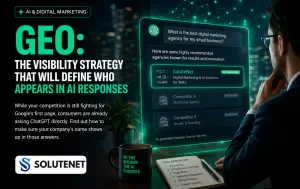
GEO: The Visibility Strategy That Will Define Who Appears in AI Responses
While your competition is still fighting for Google’s first page, consumers are already asking ChatGPT directly. Find out how to ensure your company’s name shows up in those answers.
What Changed in the Search for Products and Services
Picture this: a business owner opens ChatGPT and types something like “what is the best digital marketing agency for my small business in New York?” Within seconds, the AI responds with a list of references, explains selection criteria, and may even suggest specific names.
This scene is already a reality for millions of people. And the question every business needs to answer is: when ChatGPT, Perplexity, Google Gemini, or Copilot talks about your industry, does your company’s name come up?
If the answer is “I don’t know” or “probably not,” you are facing the biggest challenge — and the biggest opportunity — in digital marketing over the next few years.
| The number that changes everything
Traditional search engines display 10 links per page. AI-powered engines cite, on average, only 2 to 7 sources per answer. This means the filter has become much stricter — and the rules of the game have changed. |
What is GEO — Generative Engine Optimization
GEO, or Generative Engine Optimization, is the set of strategies and practices that make a business visible in responses generated by artificial intelligence. It is, in essence, the SEO of the chatbot era.
Just as traditional SEO optimizes your website to appear in Google’s list of results, GEO optimizes your content to be recognized, understood, and cited by language models such as ChatGPT, Perplexity, Gemini, and others that will emerge.
The fundamental difference lies in the response format:
- In traditional SEO: the user receives a list of links and chooses which one to click.
- In GEO: the AI delivers a direct answer, already citing the sources it considers most reliable.
- Result: either your company is the trusted source being cited, or it simply does not exist in that conversation.
Why This Matters Especially for SMEs
Large companies already have a consolidated presence: they are in news portals, have active PR departments, and have accumulated years of indexed content. For small and medium-sized businesses, competing on Google is often unequal.
GEO represents a rare window of equity: AIs do not favor the size of the budget, but rather the quality, relevance, and authority of the content. An SME that produces structured and reliable content about its niche can appear in AI responses before major competitors who still haven’t grasped this shift.
How AIs Decide What to Cite
Understanding how language models select their sources is the first step to being chosen by them. There are four main criteria:
1. Domain and Author Authority
AI values content published by recognized sources — specialized portals, reputable outlets, professionals identified by name and credentials. On your website, this means signing articles with the name of the responsible expert, their background, and experience. Anonymous content has much less chance of being cited.
2. Clear Semantic Structure
Language models “read” your content the same way they do any text — looking for answers to specific questions. Content organized with explicit questions, clear definitions, and direct answers is much easier to extract and cite. A well-structured FAQ section is invaluable in this context.
3. Original and Verifiable Data
When an AI is composing an answer, it prefers sources that present concrete data — research, statistics, client results — over generic texts full of marketing buzzwords. A real case study with specific numbers is infinitely more citable than “we serve hundreds of companies with excellence.”
4. Consistency and Updates
Outdated content progressively loses relevance. AIs prioritize sources that demonstrate they are active and up-to-date. A consistent monthly blog post beats, in GEO impact, a grand content launch followed by months of silence.
The 6 Practical GEO Actions for SMEs
The good news is that implementing GEO does not require large budgets. It requires strategy, discipline, and quality content — exactly what SoluteNet works on with its clients. Here are the concrete actions:
Action 1: AI Visibility Audit
The starting point is understanding where you stand today. Open ChatGPT, Perplexity, and Gemini and ask the questions your customer would ask: “what is the best [your service] company in [your city]?”, “how to solve [problem you solve]?”. Record the results. This is your baseline.
Action 2: Content Creation in GEAF Format
GEAF is the ideal structural format for GEO: Question → Definition → Importance → Step-by-step → Data. Every blog article should follow this structure. Don’t write to sell — write to answer real questions your customers ask.
| Practical GEAF structure example
Title: “How does a chatbot work for small businesses?” → Question: What is an AI chatbot? → Definition: A chatbot is an automated customer service system… → Importance: For SMEs, it represents up to 60% reduction in service time… → Step-by-step: 1. Business diagnosis 2. Mapping of frequently asked questions 3. Configuration… → Data: On average, companies that implement chatbots see a 35% increase in lead capture outside business hours. |
Action 3: FAQ Optimization with Schema Markup
Each service page on your website should have a questions-and-answers section. And those questions should be tagged with the technical code FAQPage — a signal that explicitly tells AI crawlers: “here are structured answers.” Plugins like Yoast or RankMath on WordPress implement this in minutes.
Action 4: Building Authority with Name and Face
Every blog article needs an identified author: full name, position, photo, and a line about their experience. AIs are much more likely to cite “article by John Smith, digital marketing specialist with 12 years of experience serving SMEs” than a post published as “SoluteNet Team.”
Action 5: Case Studies with Real Data
Turn your results into public content. You don’t need to reveal confidential information — just provide context: “client in the aesthetic health sector, with a team of 5 people, in New York.” Describe the challenge, the implemented solution, and the results in numbers. This type of content is highly citable by AIs because it is specific and verifiable.
Action 6: Editorial Presence on External Domains
Publishing content only on your own website has limits. AIs value mentions from independent sources — business portals, sector blogs, trade associations. A signed article on a respected portal in your niche is worth more for GEO than ten posts on your own blog.
Comparison: Traditional SEO vs. GEO
| Criteria | Traditional SEO | GEO |
| Objective | Appear in the list of links | Be cited in the AI’s answer |
| Result format | 10 links per page | 2 to 7 sources per answer |
| What AI evaluates | Keywords and backlinks | Authority, structure and data |
| Ideal content | Keyword-optimized | Structured to answer questions |
| Content author | Less relevant | Name and credentials are essential |
| Cases and data | Complementary | Decisive citation factor |
| FAQ on site | Good for SEO | Essential for GEO |
| Content updates | Important | Critical to maintain visibility |
What to Monitor: GEO Metrics for SMEs
One of the most common questions is: “how do I know if my GEO strategy is working?” The metrics are different from traditional SEO:
| Metric | How to Measure | Initial Goal |
| AI Mentions | Monthly manual tests on ChatGPT, Perplexity and Gemini | Appear on 1 of the 3 platforms |
| AI Bot Traffic | Server log analysis | Identify GPTBot and PerplexityBot crawlers |
| Citation Rate | Tools like Profound or Evertune | Be cited in 10% of sector queries |
| Organic article reach | Google Search Console | 15% monthly growth |
| Conversions via content | Analytics with UTMs in article CTAs | At least 1 lead per article/month |
How SoluteNet Implements GEO for SMEs
SoluteNet was created with a clear purpose: to democratize access to advanced digital marketing strategies for small and medium-sized businesses. GEO is the natural extension of this mission.
Our approach combines the competencies we have already developed in SEO, content creation, 360° Vision, and chatbot automation — now geared toward ensuring our clients become trusted sources in AI responses.
The process we apply follows three steps:
- Diagnosis: audit of current visibility on the main AI platforms and opportunity mapping by sector.
- Production: content creation in GEAF format, technical FAQ optimization, Schema Markup implementation, and production of case studies with real data.
- Monitoring: monthly tracking of GEO metrics and continuous strategy adjustments.
| Ready to appear in AI answers?
Contact SoluteNet and receive a free AI visibility audit for your business. Find out where you stand today and what to do to get where your customers will be looking tomorrow. WhatsApp: 55 (11) 95790-2977 | solutenet.com.br e-mail: guilherme@solutenet.com.br |
Frequently Asked Questions About GEO
Does GEO replace SEO?
No. The two complement each other. SEO ensures you are found in traditional Google searches, which still represent the majority of queries. GEO ensures visibility in the growing layer of users who already consult AIs directly. A complete strategy needs both fronts.
Is GEO for companies in any sector?
Yes. Regardless of the sector — healthcare, retail, services, food, technology — customers are already asking AIs about their needs. GEO adapts to the content and specific questions of each niche.
How long does it take to see results?
The first signs appear between 60 and 90 days after publishing structured content. The consolidation of authority — when your brand starts being consistently cited — generally occurs between 6 and 12 months of continuous strategy.
Does my SME have the structure for this?
Yes. GEO does not require a dedicated in-house team. With the right partner — like SoluteNet — the entire process is managed by specialists, and your role is to provide information about the business, approve content, and track results.
Which AI platforms should I prioritize?
Currently the most relevant are ChatGPT (OpenAI), Perplexity, Google Gemini, and Microsoft Copilot. Content well structured for GEO tends to work well across all platforms, as quality criteria are similar.
About SoluteNet
SoluteNet is a digital marketing agency specializing in small and medium-sized businesses. With services ranging from website creation and content management to performance campaigns, AI chatbots, and now GEO, SoluteNet operates as a strategic partner for SMEs that want to grow with intelligence and efficiency.
solutenet.com.br | (11) 95790-2977 | Monday to Saturday, 9am to 6pm